Portable Electrical Muscle Stimulation (EMS) devices have evolved from clinical physical therapy suites into compact, consumer-ready tools. While marketing often promises “a full workout while sitting on the couch,” the actual physiology of EMS tells a more nuanced—and functional—story.
1. How Portable EMS Works (The Mechanics)
Normally, your brain sends electrical signals down motor nerves to make muscle fibers contract. EMS bypasses the central nervous system by sending targeted micro-currents through skin electrodes directly to motor point nerves.
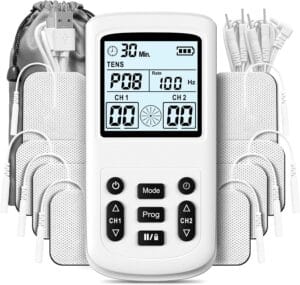
The Key Difference: EMS vs. TENS vs. Russian
EMS / NMES (Neuromuscular Electrical Stimulation): Targets motor nerves to cause actual physical muscle contractions. Used for strengthening, toning, and circulation.
TENS (Transcutaneous Electrical Nerve Stimulation): Targets sensory nerves to block pain signals to the brain. It does not build muscle.
Russian Current: A high-frequency (2,500 Hz) carrier wave modulated into low-frequency bursts. It penetrates deeper into muscle tissue with less skin discomfort.
┌──────────────────────────────────────────────────────────┐
│              VOLUNTARY vs. EMS CONTRACTION               │
├──────────────────────────────────────────────────────────┤
│ Voluntary: Brain recruits Slow-Twitch -> Fast-Twitch     │
│ EMS:       Current recruits Fast-Twitch -> Slow-Twitch   │
└──────────────────────────────────────────────────────────┘
Surgical/Rehab Note: Voluntary exercise recruits small, fatigue-resistant Type I (Slow-Twitch) fibers first, then Type II (Fast-Twitch). EMS reverses this: it forcibly recruits Type II fast-twitch power fibers first. This is why EMS causes quick muscle fatigue and is so effective for preventing atrophy.
2. Critical Technical Parameters: Frequency, Pulse & Amplitude
The efficiency of any unit relies entirely on its technical specs. If a device does not allow control over these variables, it is a glorified massager:
┌───────────────────────────────────────────────────────────────┐
│                    EMS WAVEFORM PARAMETERS                    │
├───────────────────────────────────────────────────────────────┤
│  ▲                                                            │
│  │     Amplitude / Intensity (mA)                             │
│  │     ┌─────────┐                                            │
│  │     │         │                                            │
│  └─────┴─────────┴──────────────────────────────────────────► │
│        ◄─────────►                                            │
│       Pulse Width (µs)   ◄──────────────►                     │
│                             Frequency (Hz = pulses/sec)       │
└───────────────────────────────────────────────────────────────┘
A. Frequency (Hz/ Pulses per Second)
Frequency dictates how the muscle responds:
1-10 Hz (Low Frequency): Causes muscle “twitching” or pulsing. Ideal for vascular pumping, swelling reduction, and active recovery.
20-50 Hz (Medium Frequency): Triggers smooth, tetanic (sustained) contractions. Ideal for endurance, postural re-education, and muscle strengthening.
50-85 Hz (High Frequency): Maximum fast-twitch recruitment for power, strength, and hypertrophic stimulus. Frequencies above $80\text{–}100\text{ Hz}$ cause rapid sensory fatigue and should be used sparingly.
B. Pulse Width / Duration ( Microseconds)
Measures how long each pulse lasts:
50-200 microseconds: Best for smaller muscle groups (biceps, calves, facial muscles).
200-400 microseconds: Essential for penetrating deeper into large muscle groups (quads, glutes, hamstrings).
C. Amplitude / Intensity (mA – Milliamps)
The power/depth of current. Portable commercial units typically range from 0 to 100 mA. True motor recruitment requires enough intensity to produce a visible, full muscle contraction—not just a light surface tickle.
3. Real Expectations & Clinical Results
| Goal | Can Portable EMS Achieve This? | Clinical Context & Reality |
| Fat Loss / Weight Loss | ❌ No | EMS burns negligible calories ($<20\text{–}30\text{ kcal}$ per session). It cannot spot-reduce subcutaneous fat. |
| Muscle Hypertrophy (Growth) | ⚠️ Conditional | Will not replace heavy resistance training for growth. However, when used alongside weightlifting, it enhances muscle activation. |
| Rehab & Atrophy Prevention | ✅ Yes (High) | Gold standard post-surgery (e.g., ACL tears) to wake up inhibited motor pathways. |
| Recovery & Soreness (DOMS) | ✅ Yes (High) | Low-frequency ($1\text{–}10\text{ Hz}$) stimulation acts as a pump, flushing metabolic waste without adding structural fatigue. |
4. How to Choose the Right Portable EMS Device
Avoid cheap “abdominal toner belts” sold on viral social feeds. Use this checklist to select a medical-grade or athletic-grade unit:
1. Dedicated Dual-Channel (or Quad-Channel) Controls
Ensure the device has at least 2 independent channels with separate intensity dials. This allows you to treat two different muscle groups (e.g., left quad and right quad) at different power levels simultaneously.
2. Parameter Customization
Look for devices that allow manual adjustment of Frequency ($\text{Hz}$), Pulse Width ($\mu\text{s}$), and On/Off Ramp Times. Preset-only “beauty” devices do not give you control over fatigue ratios.
3. Medical Clearance & Safety Standards
Ensure the device holds FDA 510(k) clearance or CE Medical class IIa certification as an NMES (Neuromuscular Electrical Stimulator).
4. Biphasic Waveforms
Choose devices that output Balanced Asymmetrical or Symmetrical Biphasic Waveforms. Biphasic currents prevent chemical skin burns by ensuring net-zero charge accumulation under the pads over time.